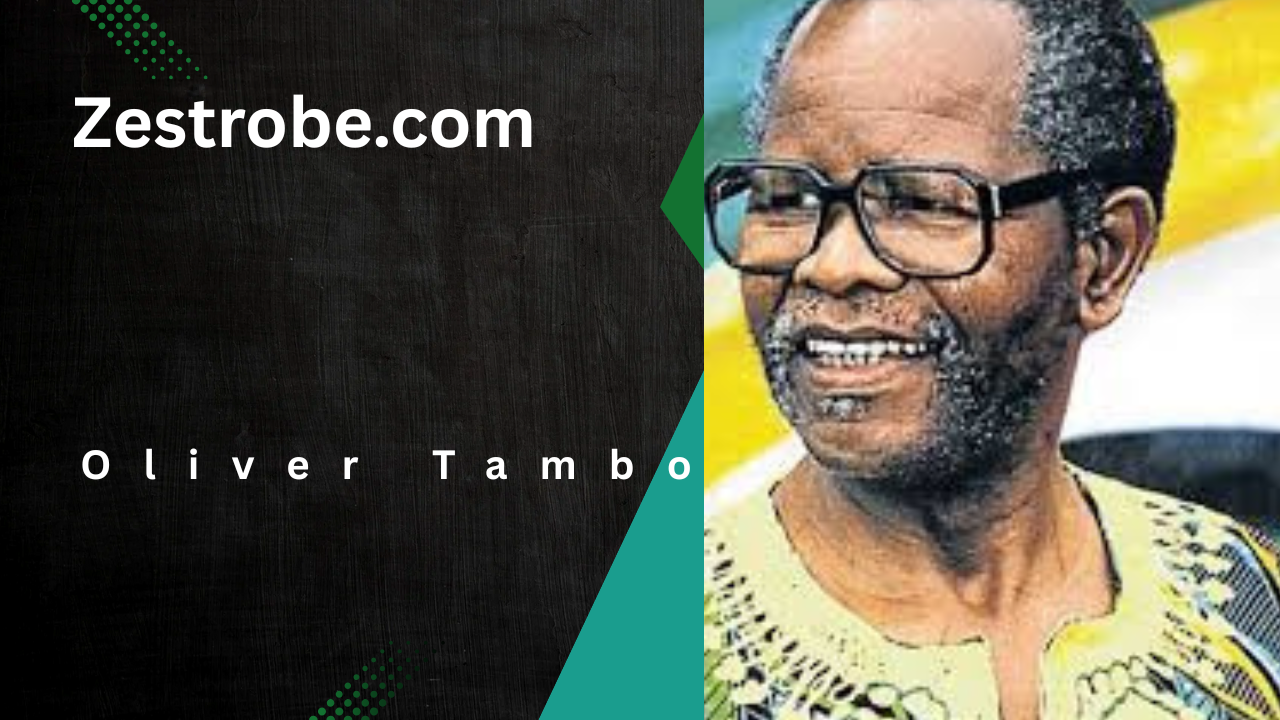
When we talk about South Africa’s long walk to freedom, names like Nelson Mandela, Walter Sisulu, and Oliver Reginald Tambo stand tall. While Mandela is celebrated worldwide, many forget the quiet but powerful leadership of Oliver Tambo, who held the African National Congress (ANC) together during decades of exile. This blog post explores his biography his early life, education, ANC leadership, and lasting legacy.
Contents
Early Life and Education of Oliver Tambo
Oliver Tambo was born on October 27, 1917, in Kantolo village near Bizana, in the Eastern Cape of South Africa. He grew up in a humble rural setting but excelled academically, eventually winning a scholarship to attend St. Peter’s College in Johannesburg.
Later, he studied mathematics and physics at the University of Fort Hare, the same institution where other future leaders like Nelson Mandela, Robert Mugabe, and Seretse Khama studied. However, his activism got him expelled in 1940.
Political Awakening and ANC Leadership of Oliver Tambo
In 1944, alongside Nelson Mandela and Walter Sisulu, Tambo co-founded the ANC Youth League to inject fresh energy into the liberation movement.
After the ANC was banned in 1960 following the Sharpeville Massacre, Oliver Tambo was tasked with leading the movement in exile. From London to Lusaka, he became the face of the ANC abroad, raising awareness, securing funding, and keeping the liberation struggle alive internationally.
While Mandela was imprisoned on Robben Island, Tambo ensured that the ANC never collapsed, even when morale was low. His diplomatic skill built ties with governments, churches, and student movements across the globe.
Role in the U.S. and Global Advocacy
Tambo frequently visited the United States during the 1970s and 1980s, meeting with civil rights groups, students, and U.S. politicians. For example, his advocacy in New York and Washington, D.C. helped influence the global anti-apartheid sanctions movement, which eventually pressured the apartheid regime economically.
In 1987, he addressed gatherings in the U.S. highlighting human rights violations in South Africa, ensuring that global media covered the atrocities of apartheid.
Legacy of Oliver Tambo
Oliver Tambo returned to South Africa in 1990 after decades of exile, witnessing the unbanning of the ANC and the release of Nelson Mandela. Although his health was failing, he continued to contribute to negotiations until his death in 1993, just one year before South Africa’s first democratic elections.
READ ALSO: Columbus Irosanga Biography: Age, Wife, Family, Career, Personal Life And Cause Of Death
Today, Oliver Tambo International Airport in Johannesburg is named in his honor, symbolizing his role as a global ambassador for South Africa’s freedom struggle. His legacy remains that of a bridge builder, strategist, and moral compass of the ANC.
The biography of Oliver Tambo is not just about one man’s life; it is about resilience, sacrifice, and international solidarity. From a small village in Eastern Cape to the halls of the United Nations and U.S. Congress, Tambo ensured the struggle for freedom never died.
His life reminds us that while some leaders fight on the frontlines, others carry the message across the globe and both roles are vital for change.

Danz has extensive experience as a senior editor at renowned publications like Money, Consumer Reports, Success, and Reader’s Digest. As a writer, his work has appeared in prestigious outlets such as The New York Times, Parade, Smithsonian, National Geographic Traveler, Investopedia, PBS NextAvenue, and Wirecutter. With over seven years of expertise, Danz specializes in personal finance, Sports, Trends and consumer topics, contributing to both major print and online platforms.